

Artificial intelligence is changing education at an extraordinary pace.
Students can now generate essays, summarise complex topics, translate languages, solve problems and access information in seconds.
But as technology becomes more capable, the experiences that cannot be replicated by AI are becoming even more valuable.
School trips give students something a screen or chatbot cannot: the opportunity to experience the world first-hand. They encourage young people to communicate, adapt, collaborate, explore unfamiliar environments and turn classroom learning into real experiences.
In the AI age, school trips are not becoming less relevant. They may be more important than ever.
AI Can Provide Information. School Trips Provide Experience.
Students have never had easier access to information.
Want to learn about the Roman Empire? AI can explain it instantly. Want to understand a scientific concept? Students can receive a personalised explanation within seconds. Want to see what the Sagrada Família looks like? Thousands of images and virtual experiences are available online.
But knowing about something and experiencing it are very different things.
Standing inside the Sagrada Família, navigating the streets of Berlin, skiing down a mountain for the first time or taking part in a watersports session with classmates creates memories and understanding that cannot be generated through a prompt.
School trips turn knowledge into experience.
And as information becomes easier to access, that distinction becomes increasingly important.
School Trips Develop the Human Skills AI Cannot Replace
One of the biggest conversations surrounding AI is how it will change the skills young people need in their future careers.
Technical knowledge will remain important, but employers are also likely to place increasing value on distinctly human capabilities, including:
- Communication
- Teamwork
- Leadership
- Creativity
- Adaptability
- Problem-solving
- Confidence
- Emotional intelligence
- Independence
These are difficult skills to develop through textbooks alone.
A school trip naturally puts students into situations where they need to communicate with others, solve small problems, manage themselves and adapt to unfamiliar surroundings.
- On an overseas sports tour, for example, students might need to communicate with opposition teams and respond to unfamiliar styles of play.
- On an adventure trip, they might have to work together during rafting, climbing or mountain activities.
- On an educational school trip, students may need to navigate a new city, communicate in another language and engage with cultures different from their own.
These experiences build the interpersonal skills students will need alongside technology.

Experiential Learning Becomes More Valuable When Answers Are Instant
AI makes finding an answer incredibly easy.
That makes another question increasingly important for education:
Can students apply what they know?
School trips create opportunities for experiential learning, where students can connect classroom concepts with real places, industries, environments and situations.
- A STEM student visiting a technology centre in Japan or South Korea isn’t simply reading about innovation. They are seeing how technology is being developed and used.
- A history student visiting Berlin can stand in locations connected to some of the defining events of twentieth-century Europe.
- A performing arts student taking part in a professional workshop can experience the discipline, collaboration and creativity involved in producing live performance.
These experiences help move learning beyond simply remembering information towards understanding, questioning and applying it.

School Trips Encourage Independence
AI is designed to make tasks easier.
For young people, however, always choosing the easiest route isn’t necessarily the best preparation for adulthood.
There is enormous value in occasionally being somewhere unfamiliar and having to work things out.
For some students, a school trip may be their first time travelling abroad without their family. It could be their first flight, their first time skiing, their first experience of another culture or simply their first time managing their own belongings and responsibilities away from home.
Small moments matter.
Remembering their passport. Arriving at breakfast on time. Preparing their equipment. Managing spending money. Sharing a room. Navigating an unfamiliar environment.
Each experience gives students another opportunity to become a little more independent.
They Get Students Away From Screens
Technology is an unavoidable part of modern education and working life.
The aim shouldn’t necessarily be to remove technology, but to make sure young people also have opportunities to engage fully with the physical world around them.
School trips naturally create those moments.
Imagine a student:
- skiing through the Alps,
- kayaking across a Mediterranean lake,
- playing a fixture against a Spanish sports team,
- walking through the streets of Rome,
- seeing Mount Fuji,
- or performing on stage with their classmates.
Those experiences involve movement, conversation, observation and genuine interaction with people and places.
AI might help students research a destination before they leave.
It cannot replace being there.

Travel Builds Cultural Understanding
AI can translate languages and provide information about almost any culture in seconds.
But genuine cultural understanding requires more than information.
Travelling allows students to experience how people actually live.
They hear different languages around them, try unfamiliar food, experience local customs and interact with people outside their normal environment.
Even seemingly small experiences — ordering food, travelling on local transport or speaking to another student — can challenge assumptions and encourage curiosity.
For schools preparing students to live and work in an increasingly international world, that experience is incredibly valuable.

School Trips Strengthen Real-World Relationships
There is another important element of school travel that can sometimes be overlooked: students spend meaningful time together.
A residential trip creates a completely different environment from the normal school day.
Students eat together, travel together, tackle challenges together and share experiences they will often talk about long after returning home.
Teachers can also see students in a different context.
A student who rarely speaks in the classroom might become a confident leader during an activity. Someone who struggles academically might excel on the ski slope, sports pitch or stage.
These experiences can strengthen friendships, improve confidence and help create a stronger sense of belonging within a school community.

AI Can Actually Make School Trips More Educational
AI and school trips don’t have to be opposites.
Used effectively, technology can make educational travel even more powerful.
Before travelling, students could use AI to research the history, geography or culture of their destination and develop questions they want to investigate.
During the trip, they can collect observations, photographs, notes and first-hand evidence.
When they return, AI can help them organise ideas, compare what they expected with what they actually experienced and reflect on what they learned.
The important difference is that AI supports the learning experience rather than replacing it.
Students aren’t asking technology to tell them what Berlin, Barcelona or Tokyo is like.
They have experienced it themselves.
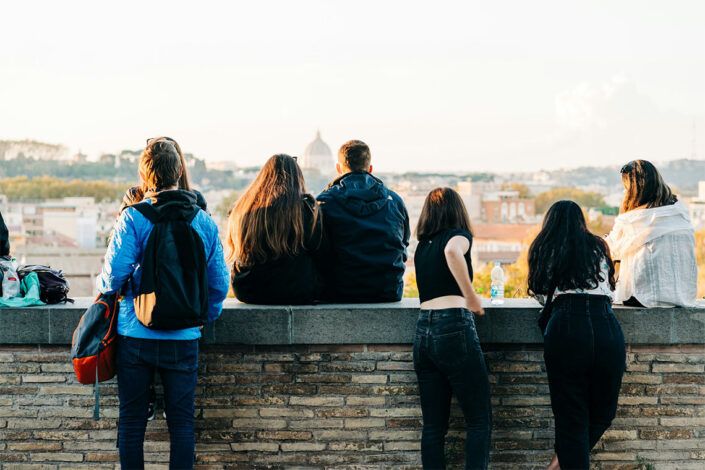
Preparing Students for an AI Future Means Giving Them More Human Experiences
Schools understandably need to prepare students for a future where AI will play an increasingly significant role.
Digital literacy and understanding how to use AI responsibly will undoubtedly form part of that preparation.
But preparing young people for an AI-driven world shouldn’t mean spending more of their education behind screens.
It should also mean creating opportunities to develop the qualities technology cannot easily replicate: curiosity, resilience, empathy, confidence, collaboration and real-world judgement.
School trips provide exactly those opportunities.

The Experiences Students Remember
Ask adults what they remember from school and the answer is rarely a particular worksheet.
They remember experiences.
Their first school ski trip.
Performing on stage.
Travelling abroad with friends.
Visiting somewhere they had previously only seen in a textbook.
Scoring against an overseas sports team.
Trying an activity they were convinced they couldn’t do — and discovering that they could.
Technology will continue to transform education, and AI will undoubtedly become an increasingly useful tool for teachers and students.
But some of the most valuable lessons will still happen away from the screen.
In an age where students can ask AI almost anything, giving them opportunities to go somewhere, experience something and discover the answer for themselves may be more important than ever.
